


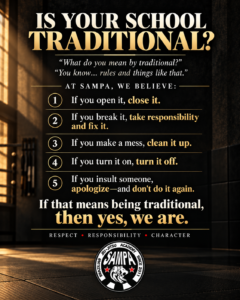
Someone recently asked me, “Is your school more traditional?”
“What do you mean by traditional?” I asked.
“You know… having rules and things like that.”
My answer was simple: at Sampa, we believe that if you open something, you should close it. If you break something, you should take responsibility and help fix it. If you make a mess, you should clean it up. If you turn something on, you should turn it off. And if you insult someone, you should apologize—and change your behavior.
If that means being traditional, then yes, we are.
These expectations express something important about our school: everyone contributes to the environment we share.
Responsibility Begins With Small Actions
Closing a door or putting equipment away may seem insignificant. But these actions give students opportunities to practice noticing how their choices affect others.
When someone leaves a mess, another person has to clean it. When equipment is treated carelessly, everyone loses access to it. A shared space works better when each person takes responsibility for their part.
We want our students to understand that caring for the academy is part of belonging to it. That applies to beginners, advanced students, and instructors alike.
Mistakes Are Opportunities to Take Responsibility
Everyone makes mistakes. Children spill things. Adults forget things. Equipment sometimes gets damaged.
What matters is what happens next.
Taking responsibility can begin with a simple statement: “I did that. How can I help make it right?”
For a young child, that might mean telling an instructor what happened and helping clean up safely. For an adult, it might mean arranging a repair or replacing something they damaged. The response should fit the person’s age, ability, and circumstances.
Our role as instructors is to guide that process with patience and consistency. Students need room to admit mistakes, accept correction, and learn how to repair the consequences.
Respect Requires Action
In Jiu-Jitsu, we depend on our training partners. They allow us to practice techniques, challenge our skills, and learn through experience. That trust carries responsibility.
Respect means listening when a partner expresses discomfort. It means controlling our movements, responding immediately to a tap, and adjusting our intensity appropriately. It also means speaking to people with consideration, especially when we are frustrated.
The same principle applies when someone says something hurtful. An apology matters, but it should lead to a change in behavior. We want students to understand what happened, acknowledge its effect, and make a better choice the next time.
Instructors Must Set the Example
These expectations apply to the people teaching the class, too.
If we ask students to be respectful, they should hear respect in the way we speak. If we expect accountability, they should see us acknowledge our own mistakes. If we ask them to care for the academy, they should see us doing the same.
Our daily behavior gives meaning to the values we teach. Students notice whether our actions match our words.
Lessons That Can Travel Beyond the Mat
At Sampa, we want students to develop habits they can carry into everyday life: taking care of shared spaces, accepting responsibility, treating people thoughtfully, and making an effort to correct mistakes.
Those habits require practice, just as physical skills do. A child may need reminders. An adult may need to reconsider a reaction. Everyone has opportunities to improve.
We value the student who helps put equipment away, welcomes a new partner, or admits a mistake without blaming someone else. Those moments deserve recognition alongside technical progress.
So, is Sampa a traditional school?
If being traditional means respecting people, caring for what we share, and taking responsibility for our actions, then yes, we are.
That is the culture we ask every student—and every instructor—to help build.