


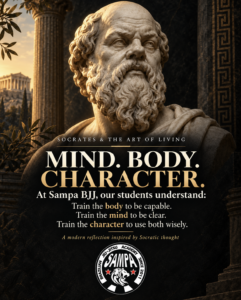
What should we develop when we practice martial arts?
At Sampa BJJ, our answer includes physical ability, clear thinking, and the judgment to use our skills responsibly. These goals shape how we teach, how we train, and how we treat one another.
Our approach can be expressed in three simple lines:
Train the body to be capable.
Train the mind to be clear.
Train the character to use both wisely.
This is a modern reflection inspired by Socratic thought, rather than a direct quotation from Socrates. It gives us a practical way to think about the purpose of martial arts education.
A technique has value. Understanding when to use it—and when to hold back—gives that ability direction.
Train the Body to Be Capable
Physical training begins with learning to move with purpose. In Jiu-Jitsu, students practice balance, coordination, positioning, and control. They gradually become familiar with movements and situations that once felt uncomfortable or confusing.
Capability looks different for each person. For a child, it may mean learning to fall safely or participate confidently in a partner activity. For an adult beginner, it may mean understanding how to move out of a difficult position. An experienced student may be working on performing a technique with greater precision and less unnecessary effort.
At Sampa, we want students to appreciate that progress happens through consistent practice. Paying attention to the basics, respecting physical limits, and caring for training partners are part of that process.
Train the Mind to Be Clear
Jiu-Jitsu presents students with problems to solve. A position changes, a partner reacts, and an approach that worked a moment ago may no longer be useful.
Those moments invite questions: What is happening? Where is my balance? Why did that movement fail? What could I try differently?
We encourage students to be curious about their training. Asking questions and examining mistakes help give practice a purpose. Instructors guide that learning by explaining decisions, inviting questions, and giving students time to explore.
Clear thinking also involves recognizing when to pause. A student who feels overwhelmed can stop, ask for help, and begin again. Learning includes knowing when more information or a slower pace would be useful.
Train Character Through Everyday Choices
Physical ability brings responsibility, especially in an activity where people place their trust in one another.
On the mat, character appears in ordinary decisions: releasing immediately when a partner taps, adjusting intensity for a beginner, listening to instructions, and admitting when we have made a mistake.
It also appears in how we respond to frustration. Can we accept correction? Can we acknowledge a partner’s success? Can we remain considerate when a training session does not go our way?
These qualities require deliberate attention. Practicing martial arts does not automatically make someone patient, respectful, or responsible. Students and instructors must choose those behaviors and reinforce them consistently.
At Sampa, that responsibility belongs to all of us.
Helping Children Understand the Purpose of Training
For younger students, these ideas need to be concrete.
“Control” can mean stopping when the instructor asks. “Respect” can mean listening to a partner who says they are uncomfortable. “Responsibility” can mean putting equipment away or helping correct a mistake.
We want our students to understand why these actions matter. Their choices help make the academy a place where others can learn and participate.
Adults have an important role in that education. Children observe how we speak, how we handle disagreements, and whether we follow the expectations we set. Our example should support our instruction.
Progress Beyond Technique
A successful training session can include many kinds of progress. A student may understand a new movement, ask a thoughtful question, manage frustration, or show greater care for a partner.
We value those moments because they reflect the kind of education we want to offer.
At Sampa BJJ, our students learn that becoming capable also means becoming thoughtful about how they use their abilities. The body performs the movement, the mind guides the decision, and character shapes the purpose.
That is the standard we practice together, one class and one choice at a time.